 Get A Quote



 English
 中文简体
Office layouts vary considerably between small home offices, compact commercial spaces, open-plan corporate environments, and large shared work areas. The same desk configuration may not suit every location. Businesses therefore need to consider available floor space, user requirements, equipment loads, and installation conditions when selecting Electric Height Adjustable Standing Desks.
An electric height adjustable desk provides a work surface that can move between sitting and standing positions through a powered lifting mechanism. This feature allows users to change desktop height without manually adjusting the frame. However, the size of the desktop, the structure of the base, and the available movement range all affect how well a particular model fits its surroundings.
Choosing a suitable configuration begins with understanding the workspace rather than selecting a desk based on appearance alone.
Electric Standing Desks for Small Workspaces
Choose Desktop Dimensions According to Daily Tasks
Small workspaces require careful use of available space. A compact desk may be appropriate for laptop-based work, online meetings, writing, and other tasks that require limited equipment.
Before choosing a desktop, identify the number of monitors, computers, documents, and accessories that will be placed on it. The surface should provide enough room for normal tasks without extending unnecessarily into walkways or storage areas.
Buyers should also consider the depth of the desktop. A surface that is too shallow may leave insufficient room for monitor placement, while an excessively deep desktop can make a small room feel crowded.
The desk's dimensions should be evaluated alongside the chair, drawers, shelves, and other furniture. Measuring the entire workstation area can help prevent problems during installation.
Consider the Desk's Minimum and Maximum Height
A compact footprint does not guarantee that a desk will fit every user. The height adjustment range must accommodate the intended sitting and standing positions.
The minimum height is relevant for users who prefer a lower seated workstation. The maximum height determines whether the desktop can reach a suitable level for standing work.
Buyers should check the actual measurements provided by the manufacturer. They should also account for desktop thickness and the height of any accessories that affect the working position.
If the desk will be used by several people, a model with programmable memory settings may help each person return to a preferred height.
Review Cable Management and Power Access
In a small room, poorly arranged cables can create clutter and interfere with nearby furniture. Electric standing desks require power for the lifting system, and connected monitors or computers may need separate cables.
Cable trays, clips, and routing channels can help keep wiring organized. Buyers should confirm which accessories are included and whether additional cable management components are available.
The location of wall outlets also matters. Cables must accommodate the desk's full movement range without becoming stretched, trapped, or disconnected. A suitable power arrangement should be planned before installation.
Electric Standing Desks for Large Offices
Standardize Workstations Across Departments
Large offices may require dozens or hundreds of desks. Standardized desktop dimensions, frame finishes, and control systems can simplify purchasing and create a consistent appearance throughout the workplace.
However, standardization should not ignore differences between departments. Employees working with multiple monitors may need a larger desktop than staff using laptops for most of the day.
A practical approach is to identify several workstation types according to their equipment and working requirements. Each type can then be matched with an appropriate desk configuration.
This method allows purchasing teams to maintain consistency while avoiding unnecessary spending on oversized or over-equipped models.
Evaluate Shared Workstation Requirements
In flexible offices, employees may use different desks throughout the week. Electric Height Adjustable Standing Desks can accommodate these changing users through adjustable height ranges and programmable controls.
For shared workstations, control panels should be easy to understand. Memory settings can reduce the time needed to return the desk to a preferred height, although the availability and number of presets vary by model.
Durability and maintenance also matter in high-use environments. Purchasing teams should ask suppliers about expected operating conditions, inspection procedures, warranty coverage, and replacement-part availability.
A clear maintenance plan can help facility managers address operational issues without disrupting the entire office.
Plan the Layout Before Ordering
Large office installations involve more than measuring individual desk dimensions. The layout must provide enough space for chairs, walking routes, storage, and access to power outlets.
The movement of the desktop should also be considered. A raised desk may bring monitors or other equipment closer to overhead shelves, windows, partitions, or wall-mounted fittings.
Before ordering, prepare a floor plan showing the desk locations, nearby furniture, cable routes, and available electrical connections. For large projects, a sample workstation can help verify the layout and assembly process.
How Frame Design Influences Space Planning
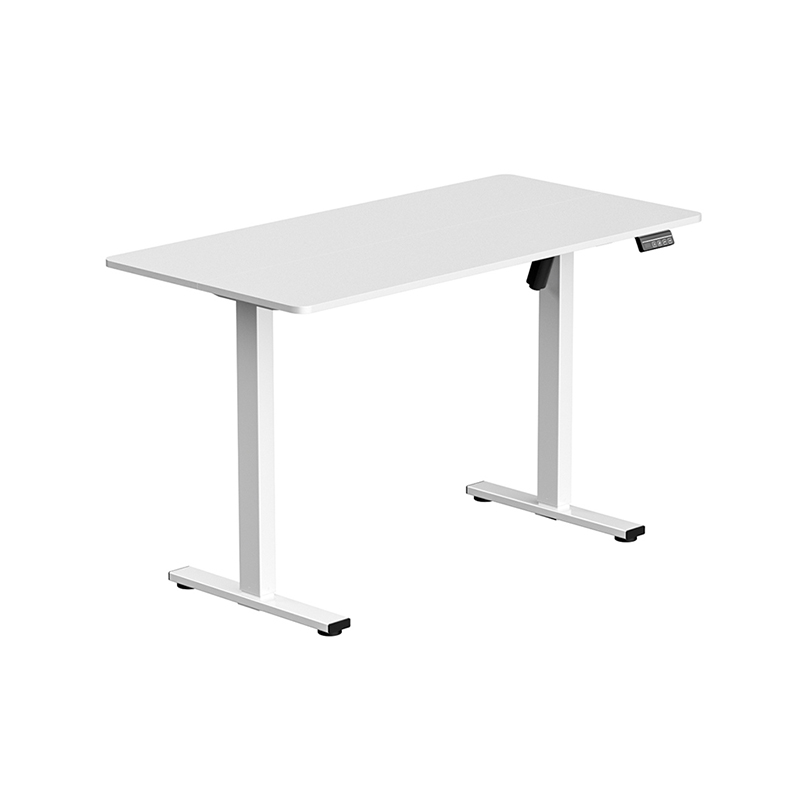
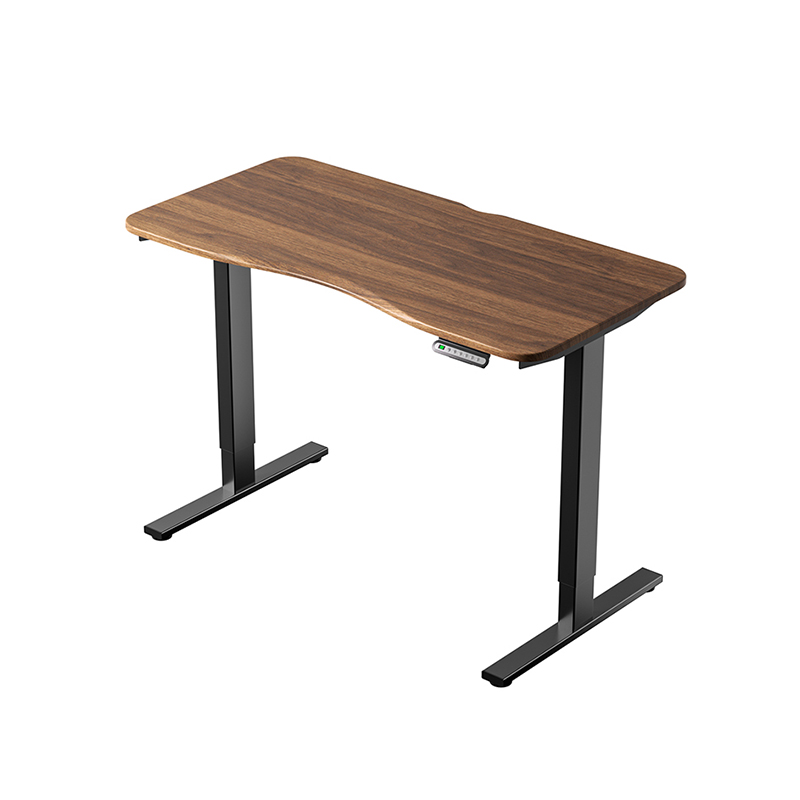
The desk frame affects both the footprint and the stability of the workstation. T-shaped and C-shaped frame configurations are common in the market, although the available options depend on the manufacturer.
A T-shaped frame can provide a relatively balanced support structure beneath the desktop. A C-shaped frame may position some structural components differently, which can affect legroom and the placement of nearby furniture.
Neither configuration should be evaluated by shape alone. Buyers should examine the frame dimensions, foot design, lifting columns, desktop compatibility, and rated load capacity.
The width adjustment range of the frame is also worth checking. Some frames can accommodate different desktop widths, while others are intended for a narrower range of surfaces. The selected desktop must be compatible with the frame's mounting arrangement.
For projects that use custom desktop dimensions, confirm compatibility with the manufacturer before finalizing the purchase.
Comparing Electric Height Adjustable Standing Desk Features
A comparison table can help purchasing teams organize the most relevant specifications.
| Feature | Small Workspace Priorities | Large Office Priorities |
|---|---|---|
| Desktop size | Compact dimensions suited to daily tasks | Standardized sizes or department-specific configurations |
| Height range | Suitable for the primary user | Suitable for a wider range of users |
| Frame design | Compact footprint and adequate legroom | Stability and consistency across installations |
| Control panel | Simple, convenient adjustment | Easy operation and useful memory presets |
| Cable management | Neat wiring in limited space | Consistent routing across many workstations |
| Maintenance | Accessible components and clear instructions | Replacement parts and organized service support |
| Packaging | Fits available delivery and storage areas | Efficient bulk transport and warehouse handling |
These priorities are general guidelines rather than fixed rules. The actual selection should reflect the desk's intended use and the specifications of each available model.
Questions to Ask Before Placing an Order
Before purchasing Electric Height Adjustable Standing Desks, businesses should confirm the desktop dimensions, adjustment range, lifting capacity, motor configuration, and frame compatibility.
For large orders, it is also useful to request a detailed quotation that identifies the exact model, finish, control panel, accessories, packaging, and warranty terms. This reduces the risk of comparing products with different specifications under similar product names.
Buyers should clarify production lead times and whether the supplier can maintain consistent specifications across repeat orders. If a project requires custom colors or desktop sizes, confirm sample approval and any minimum order requirements.
Electric Height Adjustable Standing Desks can be used in both compact workspaces and large commercial offices, but the most suitable configuration depends on the available space and the demands of daily work. Smaller rooms often prioritize desktop dimensions, cable organization, and a compact footprint, while large installations require greater attention to standardization, maintenance, and logistics.
By measuring the workspace, defining equipment requirements, and comparing complete product specifications, buyers can select desk configurations that suit their layouts and operating needs.


 Add: Building18, No. 331, Haidong Road, Lihai Street, Yuecheng District, Shaoxing City, Zhejian, China
 Tel: +86-18057599511 / +86-0575-89291658
 Fax: +86-0575-89291658
 Email:
